


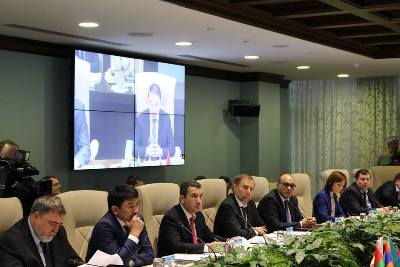

SCPEC Chairman Artak Shaboyan took part in the session of EEU member states' competitiveness bodies.
During the session, the SCPEC Chairman made a speech, presenting the contradictions in the technical regulations of the EEU, as well as suggesting changes in the number of socially significant commodity markets, revealing the unfair competition.
In particular, Artak Shaboyan said that according to the technical regulations of the Customs Union, milk and dairy products can contain both vegetable and animal oil, but they should be separated by names. For example, the product of animal origin should be called curd, and the product which contains a mixture of vegetable oils should be called a curd product, or cheese and cheese products, sour cream and sour cream product etc.
However, according to the head of the RA Competitiveness Body, studies indicate that these names are very similar and cause embarrassment among consumers. "There must be a clear separation in this issue so that the consumer knows, whether he pays for vegetable or animal oil products." A. Shaboyan suggested that the names should be very differentiated, such as butter, margarine, spread, etc.
However, there is another problem with butter. The problem is that according to the Customs Union technical regulations, butter should be made exclusively of animal oil. However, SCPEC has found out that recently it has appeared in the local market butter, which also contains vegetable oil. As it is of Russian origin, the Commission has applied to the relevant RF bodies and received an answer where it says that butter made of vegetable fat is a diet product.
According to the RA Competitiveness Body, there is an obvious contradiction here: on the one hand, it is mentioned in the technical regulations of the Customs Union that butter can be called exclusively animal food, on the other hand, "Rospotrebnadzor" confirms that butter can also be of vegetable origin, which is called dietary food.
Artak Shaboyan offered colleagues to amend the technical regulation in this regard, clearly pointing out what the dietary requirements are. "We have found a similar product in Armenia, but we have found out that this problem is also available in all EEU member countries."
Artak Shaboyan's proposal has been approved by the heads of partner organizations who have expressed readiness to take action in the near future.
The material is copyrighted and protected by law


